TaskLie Ganav

Ganav Audit · Early access

The audit file that runs like an engagement.

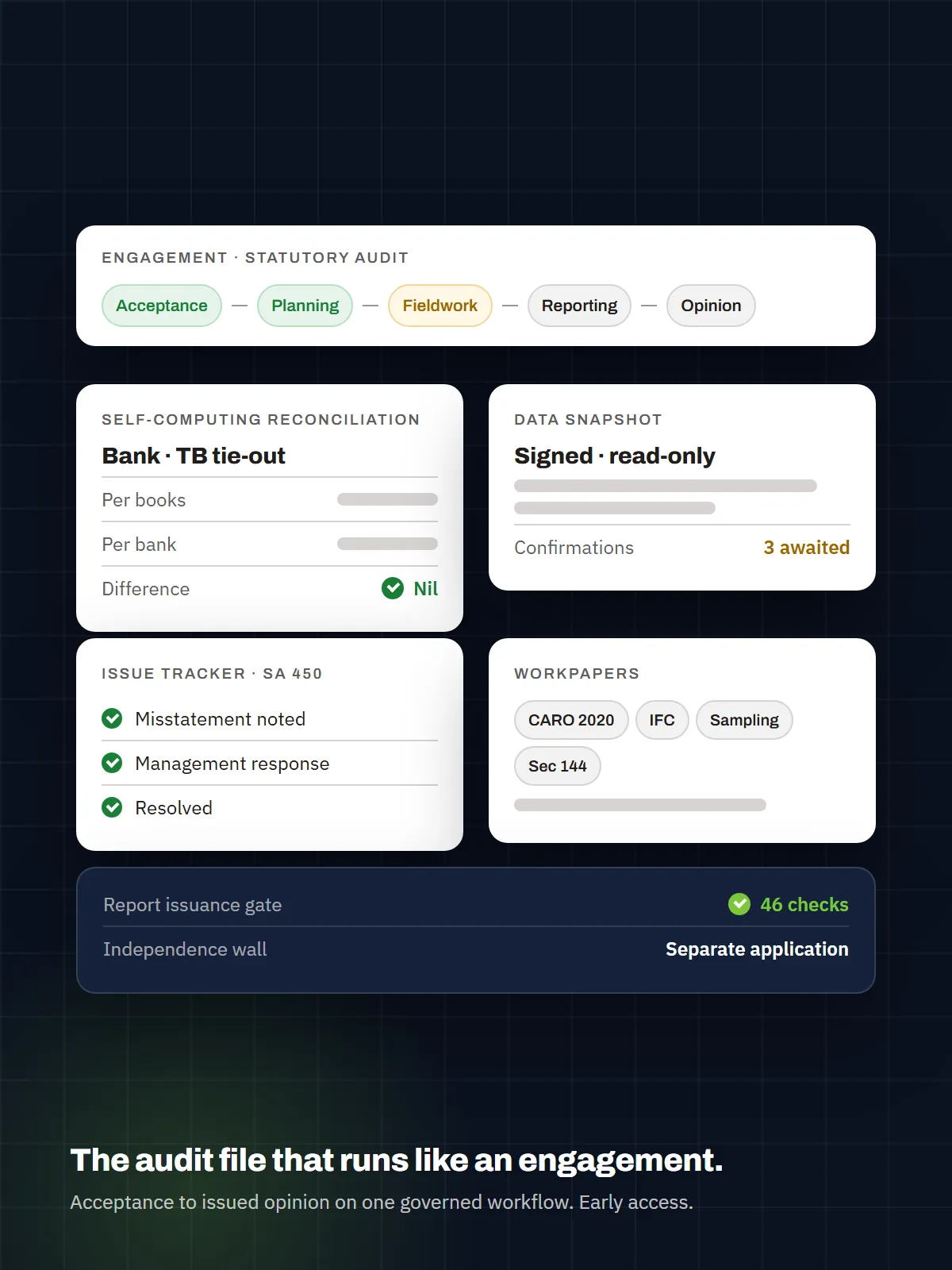
Ganav Audit takes a statutory audit from acceptance to issued opinion on one governed workflow — SA-by-SA, with the working papers, reconciliations, confirmations, CARO and IFC workpapers, and the report itself generated from the same file. Independence is enforced by architecture, not by a checklist.

Illustration: Ganav Audit: statutory audit software for CA firms in India

Why a separate product

An auditor cannot audit the books they keep. So Ganav Audit never opens the accounting database. Client data enters only as a signed, sealed snapshot — a trial balance, registers, ledgers, statements — that the audit app verifies against a pinned key before it accepts a byte. The two products share a design language and a firm, and nothing else.

  • Own application, own database, own users and roles — a partner’s audit workspace is not a tab in the bookkeeping app.
  • Section 144 independence, evaluated by the system. Team assignments are checked against the firm’s own roster and the client’s history; a conflict is refused with a named reason, and where the Act allows an attestation, the partner records it — the software never fabricates one.
  • Books-exchange contract. Data arrives as a signed release pack (from Ganav, Tally, Zoho, or any book that can export the contract’s CSV set). Tampered, stale, or unsigned packs are refused, and every refusal is on the record.

The lifecycle — Draft → Completed, with real gates

Stage What happens The gate that opens the next stage
Acceptance Client KYC, the 17-item acceptance checklist, Sec 141(3)(g) ceiling count, engagement letter Acceptance signed; team passes Sec 144
Applicability The engine works out which Accounting Standards, statutory clauses and CARO paragraphs apply to this client — with overrides and a full history Applicability confirmed
Planning Materiality (SA 320), risk matrix, fraud (SA 240) and going-concern assessment, audit programme sign-off Planning gate
Data Snapshot register: every dataset the programme needs, its status, and a STOP gate that names what is still missing All required datasets received
Fieldwork Reconciliations, confirmations, analytics, sampling, journal-entry testing, working papers Every close gate green
Conclusion Issue tracker (SA 450), CARO 2020 workpaper, IFC evaluation, conclusion procedures Three Conclusion gates
Report & issue Opinion, management representation letter, audit report with UDIN, issuance 46-item quality gate
Archive The 60-day SA 230 clock, post-lock guards — nothing edits an archived file

Every transition is a governed approval with an approvals inbox; every gate card on the Overview says what is still open and who owns it.

Fieldwork tools that compute, so your staff can judge

Reconciliations that run themselves the moment data lands.

Commit a snapshot and every reconciliation its datasets can feed computes automatically — GSTR-1 vs sales register, GSTR-3B vs books, GSTR-2B vs purchase register, Section 17(5) blocked credits, bank reconciliation with ageing tiers, TDS by section, payroll vs bank, depreciation — plus the semi-manual ones (MSME interest under Section 16 computed for you, FEMA 9/12-month flags, cash, related parties). Exceptions are classified by threshold, diffed run-to-run, and cannot be closed without an explanation or a promoted issue. The system computes and flags; a human dispositions and signs.

Confirmations (SA 505), analytics (SA 520), sampling (SA 530), JE testing.

A confirmations manager with generated letters and reminders; a ratio evaluator with red flags; statistical sampling; and journal-entry testing with the seven classic filters, an off-hours clock per engagement, and its own close gate.

Working papers and evidence, filed where the standard expects them.

Folder trees, working-paper shells created for each procedure, evidence pinned to CARO clauses automatically as reconciliations find it, senior-tag copy-forward from the prior year.

Conclusion and the report

  • Issue tracker (SA 450)misstatements summarised, aggregated against materiality, and carried into the opinion decision.
  • CARO 2020 workpaperclause by clause, with the evidence the fieldwork already produced.
  • Internal financial controlsthe IFC evaluation on the same issue-tracker rails.
  • Seven documents rendered live from the fileengagement letter, confirmation letters, management representation letter, the audit report with its opinion variant and Rule 11(g) clause, and more — with a fail-loud token policy: every placeholder is filled or visibly marked “(not on file)”.
  • The quality gate46 checks before an opinion can be issued, so the file is complete when the signature goes on.

Built for how a firm actually works

  • Weekly board and role dashboardsthe partner sees every engagement’s stage and its open gates; managers see their team’s queue; staff see their tasks.
  • Acceptance pre-checks from the app’s own dataclient-vs-roster name matches as a lead (never a verdict), Sec 144 evidence state, the 141(3)(g) count from the firm’s own engagement book — placed beside the checklist, never written into it. The human-only items stay human.
  • Account security on by defaultadmin-enforced two-factor with forced enrolment at next login, sign-out-everywhere, and a users screen a firm admin can run without engineering.
  • Same governance DNA as Ganavmaker–checker on the transitions, immutable audit trail, correlation IDs on every request.

Honest scope

  • Ganav Audit is for statutory audit files. It does not keep books, and by design it cannot read the bookkeeping database.
  • Applicability rules, reconciliation thresholds and explanation categories ship with CA-reviewed defaults and are the firm’s to edit; where the profession’s guidance is genuinely contested, the software does not pick a side.

Bring one completed audit file. We'll show you the same engagement, gated.